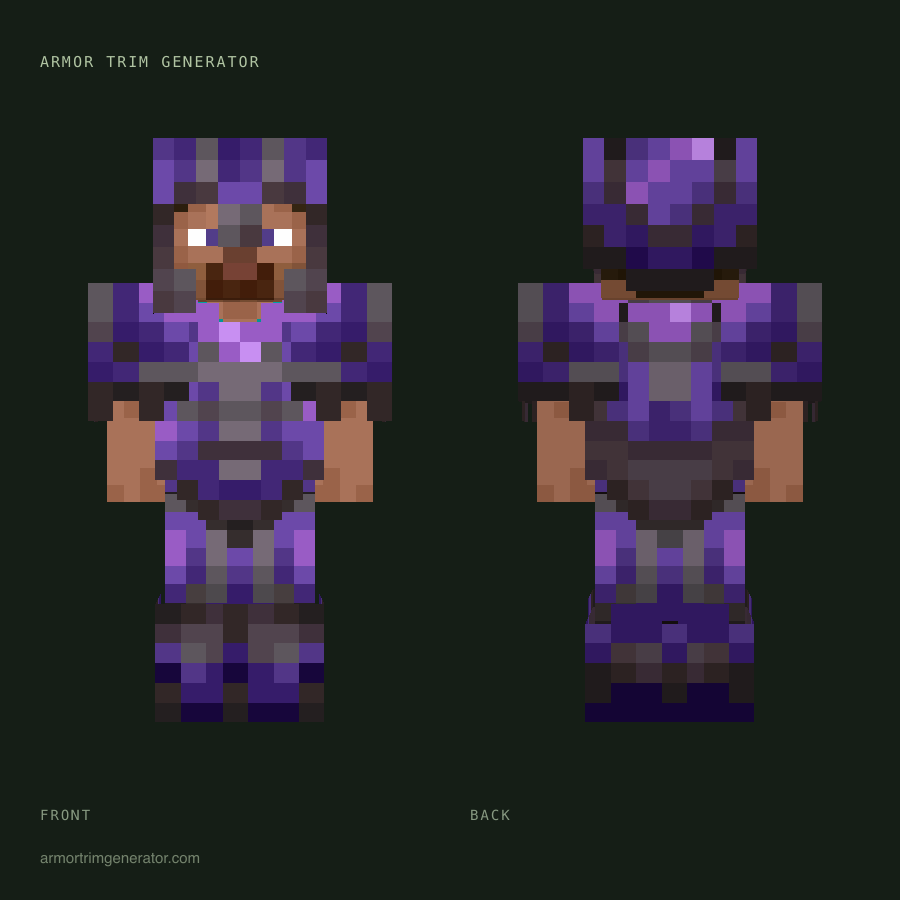
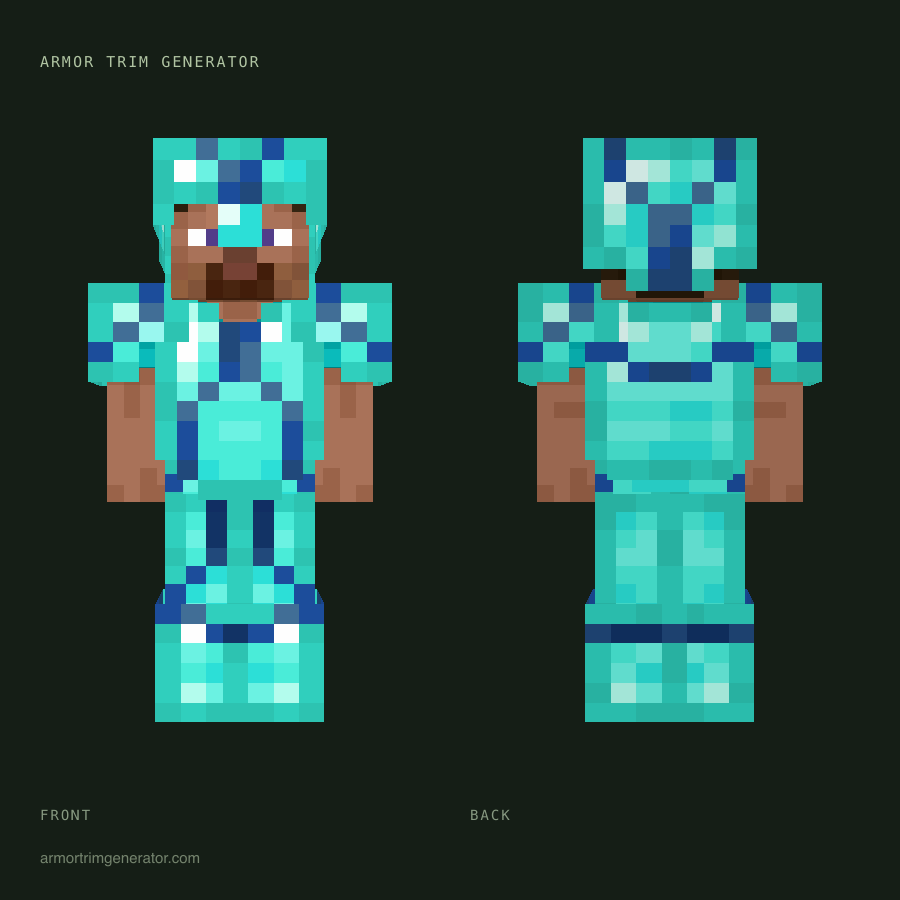
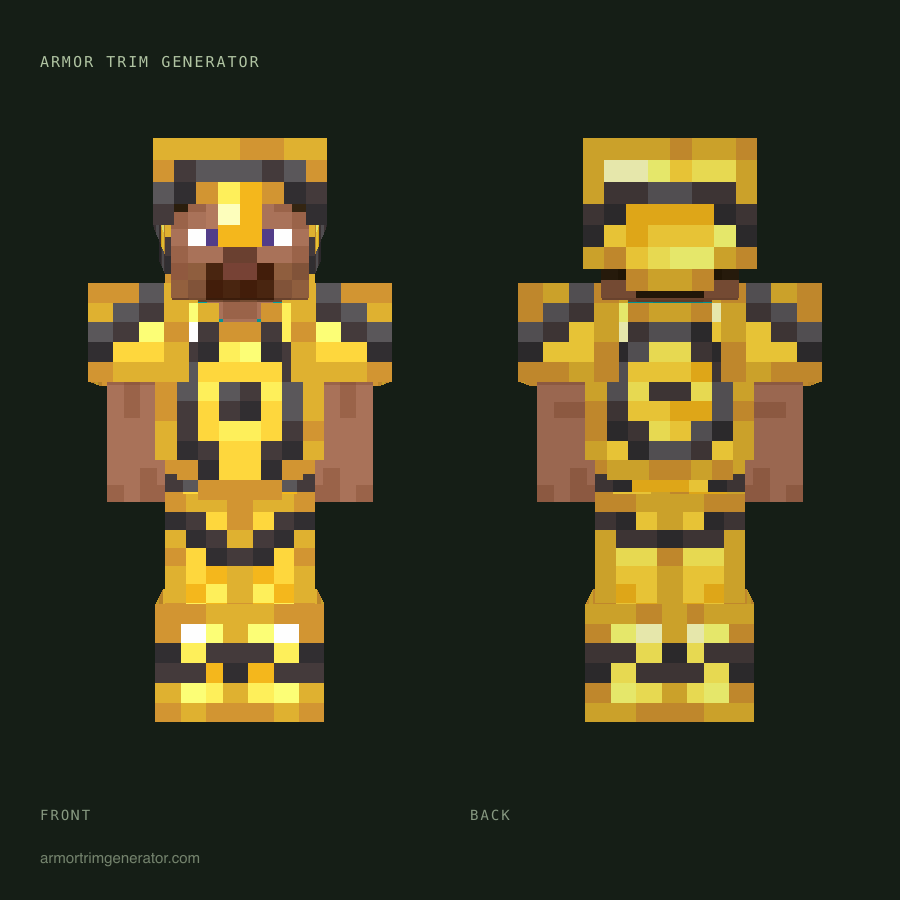
See it before you smith
no wasted netherite templates or rare trims
Design your perfect armor look — try all 18 trim patterns, mix materials and colors, and preview live on Alex, Steve, or your own skin.
A few looks to get your next build started.
Don't start from scratch — upload your skin file and see exactly how each trim looks on YOUR character before you spend a single smithing template in-game.
no wasted netherite templates or rare trims
every trim in one place
runs in your browser, no download, no login
Know where to look, what to bring, and which pattern belongs on your next set.
See all armor trims →The questions players actually search before spending a smithing template — answered with the checked odds from our trim guides.
The Silence armor trim. Its smithing template appears in regular ancient city loot chests at a 1 in 80 chance (1.25%) — the lowest odds of all 18 patterns in Java and Bedrock 1.21. For comparison, Ward sits in the same chests at 5%, so a Silence hunt usually takes more than one city.
Silence armor trim templates hide in the normal chests of ancient cities; the separate ice box chests never contain one. Each eligible chest has a 1.25% chance to hold a template in Java 1.21 and Bedrock 1.21.0. Found one? Duplicate it with cobbled deepslate plus seven diamonds, and preview it on every material in the generator above before you commit.
Open the Silence armor trim guide ↗No. Applying a trim at a smithing table is permanent — Minecraft has no way to remove a pattern or restore an untrimmed piece, so the only way back is brand-new armor. The application keeps your enchantments and durability, so what you are risking is style, not stats. That is exactly why this generator exists: settle on the look here first, then spend templates in game.
Each pattern lives in its own structure: Coast in shipwrecks, Dune in desert pyramids, Eye in strongholds, Rib in Nether fortresses, Sentry in pillager outposts, Snout in bastion remnants, Spire in End cities, Tide from elder guardians in ocean monuments, Vex in woodland mansions, Wild in jungle pyramids, Silence and Ward in ancient cities, Host, Raiser, Shaper, and Wayfinder from brushing suspicious gravel in trail ruins, and the 1.21 pair Flow and Bolt in trial chambers. The directory below links a guide with exact odds for every one of them.
Use a smithing table with its three slots: the armor piece, the trim smithing template, and a trim material. The material sets the color — amethyst, copper, diamond, emerald, gold, iron, lapis lazuli, netherite, quartz, or redstone — while the pattern supplies the shape. Trimming never consumes enchantments, and using the same material as the armor itself gives a darker tone-on-tone version of the pattern.
Combine the template with seven diamonds and its matching block in a smithing table to get two templates back. The block depends on the pattern: cobblestone for Coast and Sentry, cobbled deepslate for Silence and Ward, prismarine for Tide, terracotta for the four trail ruin trims, and so on. Every trim page lists its exact copy recipe.
18 patterns and 10 trim materials make 180 different looks per armor piece — 720 across a full four-piece set before you even count base armor types, the turtle helmet, or leather dye. The generator above handles all of them, including a different pattern and material on every piece.
Nothing in combat. Trims are purely cosmetic — the same armor points, durability, and enchantments as the plain piece. They signal exploration history, loot luck, and taste rather than power, which is why planning the palette first matters more than it does for any other piece of gear.
We ranked six full netherite looks on the best combos page. Highlights: Amethyst Afterdark (Silence + amethyst) for violet crystal lines on dark plate, Ender Regalia (Eye + emerald) for a ceremonial chest emblem, and Crimson Depths (Ward + redstone) for a Nether expedition feel. Each pick ships with a front-and-back preview and loads into the generator in one click.
See the ranked netherite combos ↗Flow and Bolt, the two patterns added in Minecraft 1.21. Flow drops from ominous vaults — a 22.5% chance per unlock with an ominous trial key — and duplicates with a breeze rod. Bolt comes from regular vaults and reward chests at 1 in 16 (6.25%) and duplicates with a block of copper.
Read the Flow trim guide ↗Wild, most likely: jungle pyramid chests hold two Wild templates at a 1 in 3 chance (33.3%), and jungle temples are easy to loot early. Sentry is another quick win at 25% in pillager outpost chests. Both comfortably beat the 8.3% per-block odds of brushing suspicious gravel in trail ruins.
Yes. Trims work on all four armor slots — helmet, chestplate, leggings, and boots — and the turtle helmet accepts them like any other helmet, even though it cannot take a netherite upgrade. The generator supports trimmed turtle helmets as well.
The trim sits on the armor, but your skin fills every gap the pattern leaves — face, arms, and hands, plus the entire look under chainmail or leather. The same trim can read calm or loud depending on the palette around it, which is why the preview lets you upload your own 64 × 64 skin before you decide.
Java Edition 1.20 and Bedrock 1.20.0 introduced armor trims, and Flow and Bolt arrived with the trial chambers in 1.21. This site mirrors Java 1.21 / Bedrock 1.21.0 exactly and deliberately leaves out later additions such as resin.